
Accessibility is becoming an increasingly important part of commercial building design across Ontario. For Toronto businesses, having attractive signs is no longer enough. Signage should also help people of different abilities navigate buildings independently, safely, and comfortably.
With Ontario’s updated Building Code accessibility provisions and an important AODA reporting deadline approaching in December 2026, now is a useful time for businesses to review their signage.
From Braille signs in Toronto to accessible washroom signs and tactile room identification, choosing the right signage can improve the visitor experience while helping businesses address applicable accessibility requirements.
In this guide, we explain AODA signage requirements in 2026, the types of signs businesses should consider, common installation mistakes, and how to choose suitable accessible signage in Toronto.
What Are AODA Signs and Why Are They Important?
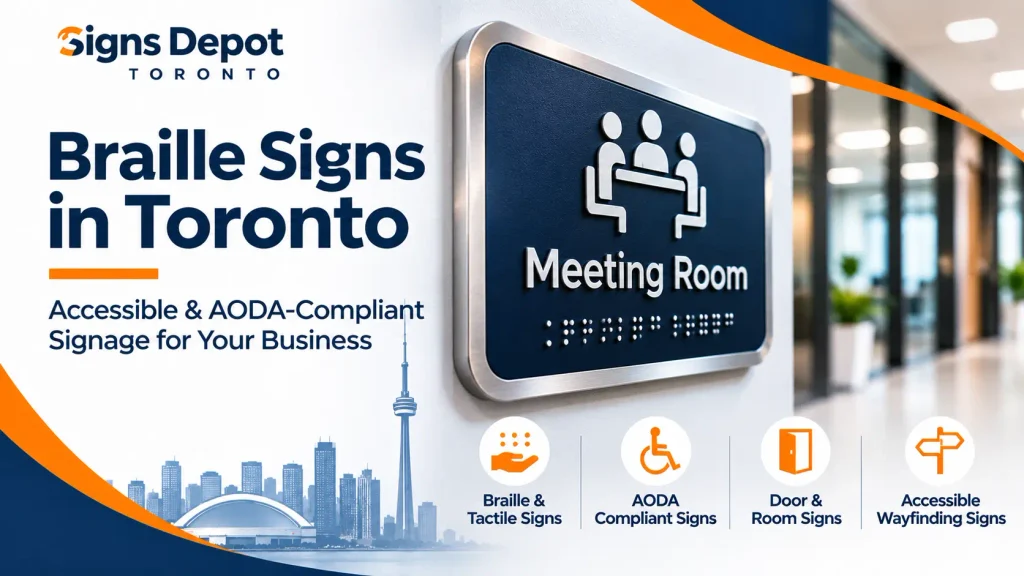
AODA signs are accessibility-focused signs designed to help individuals with disabilities identify rooms, locate facilities, follow directions, and navigate public or commercial environments.
AODA stands for the Accessibility for Ontarians with Disabilities Act, 2005. Ontario’s accessibility framework works alongside the Ontario Building Code and applicable technical standards to reduce barriers.
Depending on where they are used and the requirements that apply, accessible signs may incorporate:
- High-contrast colours for better visibility
- Braille and raised tactile lettering
- Recognizable accessibility symbols
- Clear, easy-to-read typography
- Consistent placement and directional information
- Durable, non-glare materials
Businesses looking to improve their facilities can explore custom AODA signs in Toronto to understand the available signage options.
AODA Signage Requirements in Ontario for 2026
Ontario’s 2024 Building Code introduced updated accessibility provisions that affect applicable new construction and extensive renovations. These requirements are particularly relevant when planning commercial signage for newly developed or substantially renovated properties.
1. Braille and Tactile Signage
Braille and tactile signs help visitors with vision disabilities identify rooms and facilities through touch.
Where tactile signage is required under the applicable Building Code provisions, it must follow relevant CSA B651 requirements.
Common applications include washroom identification, room identification and other designated facilities.
Not every sign requires Braille. The requirement depends on the sign’s function, location and applicable building rules.
2. Accessible Washroom Signs
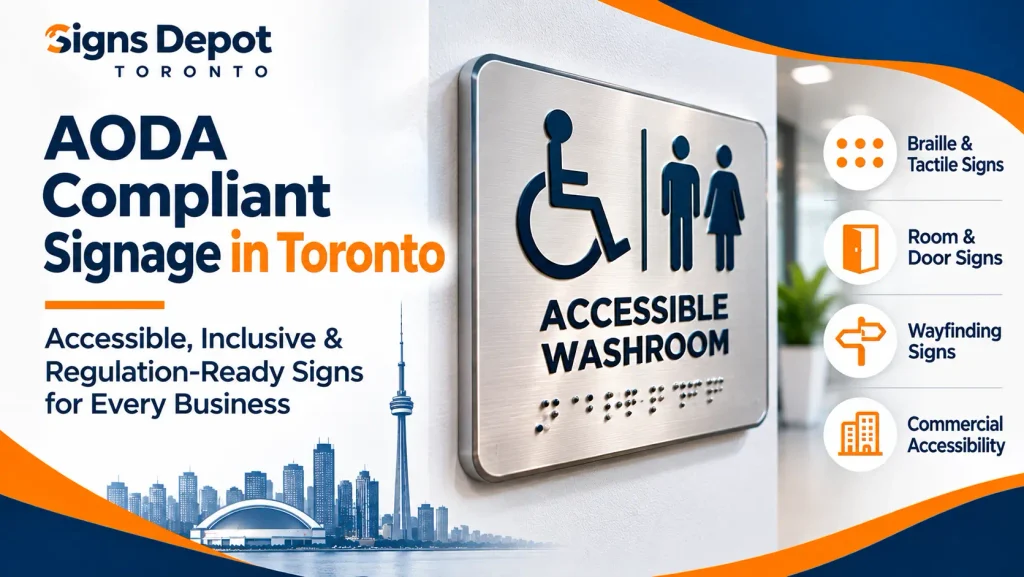
Accessible washroom signage should clearly identify facilities designed for people with disabilities.
Depending on the situation, signs may need:
- The International Symbol of Access
- Clearly readable lettering
- Tactile and Braille information
- Consistent positioning near the facility
- Directional information leading to accessible washrooms
For businesses updating commercial interiors, combining accessible signs with properly planned door signs in Toronto can create a consistent identification system.
3. High-Contrast and Readable Signs
A visually attractive sign is not necessarily accessible.
Low-contrast lettering, decorative fonts, reflective surfaces and crowded layouts can make information difficult to read.
Effective AODA accessibility signage prioritizes readable typography, suitable contrast, appropriate character sizing and clear visual organization.
Design choices should reflect applicable technical standards rather than relying only on appearance.
4. Accessible Directional Signage
Large offices, shopping centres, educational institutions and healthcare facilities often require visitors to navigate multiple corridors, entrances and service areas.
Clear directional signage can identify:
- Accessible entrances and ramps
- Elevators and accessible washrooms
- Accessible parking areas
- Reception and customer service locations
- Building routes and relevant accessible facilities
Well-planned wayfinding signs in Toronto can help visitors reach their destination without unnecessary confusion.
Why the December 2026 AODA Deadline Matters
Under Ontario’s accessibility reporting rules, businesses and non-profit organizations with 20 or more employees generally must submit their next accessibility compliance report by December 31, 2026.
This reporting requirement does not automatically mean every business must replace all its signs by that date.
However, it is an opportunity to review accessibility practices and identify signage improvements where necessary.
A useful review can examine whether accessible facilities are properly identified, whether directional signs are readable, and whether tactile signage meets applicable requirements.
Business owners should distinguish between AODA reporting obligations and specific signage obligations under building legislation.
Five Types of Accessible Signs Toronto Businesses Should Consider
1. Custom Braille Signs
Custom Braille signs provide tactile information for people who are blind or have low vision.
These signs can be used for room identification, washrooms and other locations where tactile information is required or beneficial.
2. Accessible Washroom Signs
Washroom accessibility signs help visitors identify available accessible facilities quickly and confidently.
3. Tactile Door Signs
Tactile door signs use raised lettering and, where applicable, Braille to make room information available through touch.
They are particularly valuable in schools, offices, institutional buildings and healthcare environments.
4. Accessible Wayfinding Signs
Directional signs help visitors find entrances, elevators, reception desks and other important facilities.
An accessible wayfinding system should consider the entire visitor journey instead of treating each sign as an isolated item.
5. Accessible Office Signs
Offices can benefit from a coordinated system covering meeting rooms, washrooms, departments and shared facilities.
Businesses planning workplace renovations can explore custom office signs in Toronto alongside accessibility-specific signage.
Common AODA Signage Mistakes Businesses Should Avoid
Even newly installed signs may create accessibility challenges if their design or placement has not been properly reviewed.
Using decorative fonts: Highly stylized lettering can make essential information difficult to identify.
Ignoring tactile requirements: Printed lettering alone may be insufficient where tactile characters and Braille are required.
Poor sign placement: Signs installed in inconsistent or obstructed positions can be difficult to locate and use.
Choosing reflective finishes: Excessive glare can reduce readability under certain lighting conditions.
Creating inconsistent directions: Conflicting arrows or unclear instructions can cause visitors to take incorrect routes.
Before installation, businesses should review the relevant accessibility and building requirements for their premises.
How to Choose the Right AODA Signs for Your Toronto Business
Choosing accessible signage requires more than selecting a size, colour and material.
Start by identifying the purpose of each sign. Room identification, directional information and accessible facility identification may have different requirements.
Next, review the building layout and establish where visitors need information.
Consider whether tactile text, Braille, specific accessibility symbols or other design features are necessary.
Finally, check the mounting locations and technical requirements before production.
Professional sign installation services in Toronto can support the physical installation process, although regulatory compliance should be confirmed against the applicable standards and approved building plans.
Why Choose Signs Depot Toronto for Accessible Signage?
At Signs Depot Toronto, businesses can explore custom signage solutions designed for commercial, office and public-facing environments.
The company’s range includes AODA signs, door signs, office signs and wayfinding signs, helping businesses plan coordinated signage across their premises.
Whether you are updating an office, renovating a retail location or planning signage for a new commercial space, choosing appropriate materials, clear messaging and thoughtful placement can make a meaningful difference.
Explore AODA signs in Toronto to learn more about available solutions.
Frequently Asked Questions About AODA Signs
1. What are AODA signs?
AODA signs are accessibility-focused signs used to identify facilities, communicate information and assist navigation for people with disabilities in Ontario.
2. Are Braille signs mandatory in Ontario?
Braille is required on certain tactile signs under applicable Ontario Building Code provisions. It is not automatically mandatory on every sign in a building.
3. What is the AODA compliance reporting deadline in 2026?
For businesses and non-profit organizations with 20 or more employees, the next accessibility compliance reporting deadline is December 31, 2026.
4. Where should accessible signs be installed?
Common locations include accessible washrooms, entrances, elevators, room entrances and directional decision points. Exact placement depends on the sign type and applicable requirements.
5. Do all Toronto businesses need AODA signs?
Applicable requirements depend on factors including the building, facilities, type of sign, construction work and relevant legislation.
6. Can AODA signs match a company’s branding?
Yes. Accessible signs can complement a business’s branding while meeting applicable requirements for readability, contrast, tactile information and symbols.
7. What materials are used for accessible signs?
Common materials include acrylic, metal and durable plastics. Material selection should account for tactile production, visibility, cleaning and environmental conditions.
8. Where can I order custom AODA signs in Toronto?
Businesses can contact Signs Depot Toronto to discuss custom AODA signs and related commercial signage requirements.
Make Your Toronto Business More Accessible With the Right Signage
Accessible signage is an important part of creating welcoming, navigable commercial spaces.
As Toronto businesses review their facilities in 2026, investing in properly designed AODA signs, Braille signage and accessible wayfinding signs can help improve the experience of customers, employees and visitors.
Looking for custom AODA signs in Toronto?
Explore Signs Depot Toronto’s AODA signage solutions or request a signage consultation to discuss your project.