A customer walking along Queen Street, browsing in Yorkville or visiting a commercial plaza in North York may pass dozens of businesses within minutes. Some storefronts are immediately recognisable. Others are difficult to identify even when the customer is standing directly outside.
The difference is not always the size or cost of the sign. Often, it comes down to readability, lighting, placement and how well the signage matches the business.
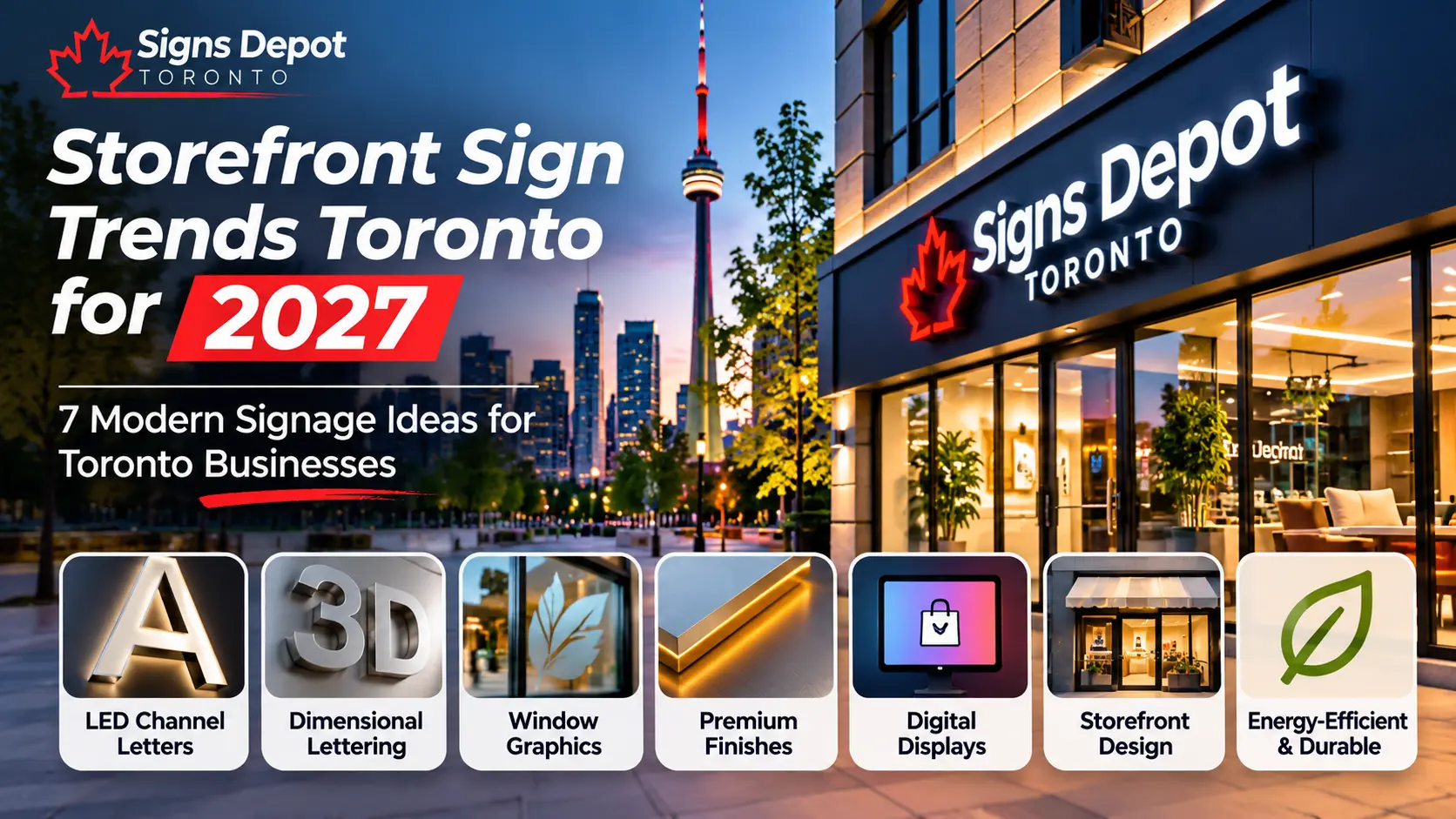
As 2027 approaches, storefront sign trends in Toronto are moving toward designs that combine clean branding with practical visibility. Businesses are exploring dimensional lettering, modern LED lighting, custom finishes and coordinated window displays.
Here are seven signage ideas worth considering before upgrading your storefront.
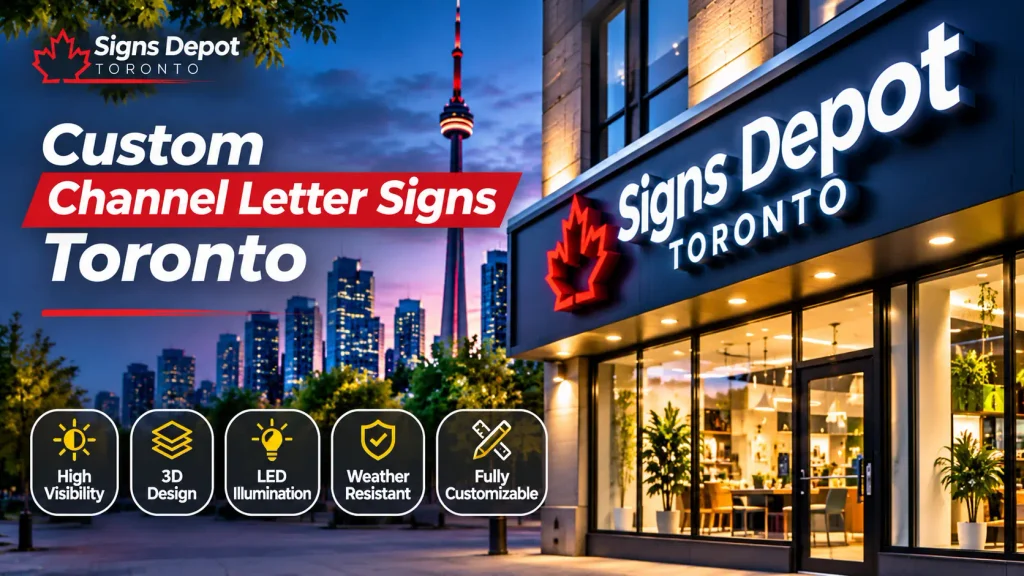
1. Illuminated Channel Letters With Cleaner Designs
One direction gaining attention is the combination of simple typography and dimensional lighting.
Instead of crowded signs containing several messages, businesses are choosing prominent brand names with clean letter spacing and carefully selected illumination.
LED channel letter signs can provide visibility after dark while adding depth to a building exterior.
Front-lit letters offer direct illumination, while halo-lit letters create a softer glow behind the lettering.
For example, a restaurant that operates late into the evening may prefer bright, readable front-lit lettering. A professional office may choose understated halo illumination to complement its architecture.
Businesses can explore custom channel letter signs in Toronto to compare different fabrication and lighting styles.
The important decision is not which lighting effect looks most impressive in a mockup, but which remains readable at the actual location.
2. Minimalist Storefront Signs That Are Easier to Read
A sign does not need five colours, three fonts and several slogans to attract attention.
In fact, those elements can compete with the information customers need most: the business name.
For 2027, clean layouts and strong typography remain useful design choices, particularly for retail stores, clinics, salons and professional offices.
A minimalist sign might feature white dimensional letters on a charcoal background or a carefully spaced logo on a neutral aluminium panel.
The design should be tested from the pavement, across the road and from relevant approach angles.
A storefront may look attractive in a close-up photograph but become difficult to read from a distance.
3. Window Graphics That Work With Exterior Signage
Storefront windows offer valuable space for communicating information without overcrowding the main sign.
Custom window graphics in Toronto can display operating hours, product categories, promotions, brand elements and other useful details.
For example, a bakery might use its main sign for brand recognition while keeping seasonal offers and opening hours on the glass.
A fitness studio could use partial-coverage graphics to provide privacy while still allowing natural light into the building.
The key is balance.
Covering every window with promotional material can make a business feel closed off. Well-planned graphics should support the storefront rather than compete with it.
Businesses can explore window graphics and storefront vinyl designs for branding, privacy and promotional applications.
4. Dimensional Lettering With Premium Material Finishes
Three-dimensional signage is not limited to illuminated letters.
Businesses can also use raised acrylic, metal or other suitable lettering to create depth through shadows and material contrast.
A boutique might choose brushed-metal lettering. A design studio could use matte-black raised letters. A wellness clinic may prefer a softer neutral finish that complements its entrance.
These details can communicate different brand personalities without relying on complicated graphics.
However, material selection should consider weather exposure, cleaning requirements, mounting and maintenance.
Toronto’s winter conditions make proper fabrication and installation particularly important for exterior signage.
5. Combining Permanent Signs With Flexible Promotions
A permanent storefront sign and a temporary promotional message serve different purposes.
The main sign identifies the business. Seasonal graphics, posters or digital displays communicate information that changes.
For example, a clothing retailer can maintain one consistent exterior sign while updating window promotions throughout the year.
A restaurant may use fixed illuminated lettering outside and an easily updated digital menu inside.
This approach avoids replacing expensive permanent signage whenever a promotion changes.
Businesses should choose digital displays according to actual operational needs rather than adding screens simply because they appear modern.
6. Signage That Matches the Building Architecture
A sign should not look like it was attached to the building without considering the surrounding space.
Facade colour, entrance position, window proportions, neighbouring signs and available mounting surfaces all influence the final design.
For example, a narrow storefront may benefit from compact lettering with strong contrast, while a wider commercial frontage may accommodate larger dimensional signs.
A business inside a multi-tenant plaza may also need to follow landlord signage guidelines.
Professional storefront sign design services in Toronto can help businesses evaluate sign styles that suit their premises, identity and visibility requirements.
For 2027, this building-first approach is more useful than choosing a fashionable sign style without considering installation conditions.
7. Practical, Energy-Conscious and Maintainable Signs
Businesses are increasingly considering how signage performs over its useful life, not just on installation day.
LED illumination, durable materials and accessible electrical components can make maintenance more manageable.
However, energy efficiency depends on the actual lighting system, usage pattern and installation.
A good sign design should account for how technicians will access lighting components, whether the surface can be cleaned safely and how damaged elements might be repaired.
These decisions may not be visible in the finished sign, but they can affect long-term ownership costs.
Which Storefront Sign Is Best for Your Business?
Different businesses have different requirements.
| Business type | Signage option worth considering | Main advantage |
|---|---|---|
| Restaurants and cafes | Illuminated channel letters | Evening visibility |
| Retail boutiques | Dimensional lettering | Distinctive brand appearance |
| Salons and spas | Halo-lit signs | Soft, premium visual effect |
| Professional offices | Metal or acrylic lettering | Clean corporate presentation |
| Grocery and convenience stores | Illuminated storefront signs | Readability from nearby streets |
| Seasonal retailers | Window graphics | Flexible promotional messaging |
The best choice depends on location, operating hours, brand identity, budget and site restrictions.
What Is the Process for Installing a New Storefront Sign?
Before ordering a sign, businesses should understand the main execution stages.
- Site assessment: Review storefront dimensions, mounting conditions and viewing distances.
- Design consultation: Select lettering styles, colours, illumination and appropriate materials.
- Artwork approval: Confirm layout, dimensions, logo proportions and fabrication specifications.
- Permits and approvals: Determine applicable City of Toronto requirements and obtain necessary landlord or municipal approvals.
- Fabrication: Manufacture sign components based on approved drawings.
- Professional installation: Mount the sign safely and complete required electrical connections.
- Final inspection: Check alignment, illumination, appearance and operational performance.
Not every project requires identical steps. The exact process depends on sign type, property conditions and applicable approvals.
Frequently Asked Questions
What storefront sign styles are expected to be popular in Toronto in 2027?
Clean channel lettering, halo-lit signs, dimensional logos, premium material finishes and coordinated window graphics are likely to remain relevant based on current industry directions.
Are illuminated signs better than non-illuminated signs?
Illuminated signs can be useful for businesses operating after dark, while non-illuminated dimensional signs may suit daytime businesses and certain architectural settings.
Do storefront signs require permits in Toronto?
Permit requirements depend on the sign type, dimensions, illumination and installation location. Businesses should verify applicable requirements before fabrication.
How much does a custom storefront sign cost in Toronto?
Costs vary according to size, materials, lighting, design complexity, permits and installation. A site-specific quotation is the most reliable way to establish a budget.
How long does storefront sign installation take?
Timelines depend on design approvals, fabrication complexity, permit requirements and installation conditions. Ask for a project schedule that separates approval, production and installation stages.
Final Thoughts
The most valuable storefront sign trends for Toronto businesses in 2027 are not necessarily the most expensive or visually complicated.
A well-designed sign should make a business easier to recognise, communicate its identity and work effectively in its actual environment.
Whether you are opening a new retail store, renovating a restaurant or updating an existing commercial property, focus on readability, durability, lighting and suitable materials.
Signs Depot Toronto provides custom signage solutions covering consultation, design, production, permitting coordination and installation. Businesses planning new storefront signage can request a project-specific consultation to explore suitable options.